
What Is a Marketing Engineer?
A marketing engineer is the person who builds the systems marketing runs on — the automations, integrations, data pipelines, and AI workflows that turn a team's tools into one working machine. The title is new; the job has been forming for years inside roles like marketing ops, growth engineering, and technical marketing. What made it a distinct role is AI: someone has to wire the models to the company's actual data, workflows, and guardrails, and that someone is the marketing engineer.
Why the role exists now, by the numbers
The role emerged from a measurable gap. Adoption is near-universal — 87% of marketers use generative AI in at least one workflow (Salesforce State of Marketing 2026) — but production is rare: organizations report 90.3% AI-agent adoption with only 23.3% reaching production (MarTech.org, 2026). The main causes are structural: the average marketing stack runs 22 distinct tools (Gartner via Influencers-Time, 2026), 65.7% of organizations name data integration their biggest challenge (MarTech.org), and AI pilots fail at 65% in fragmented 15+ tool stacks versus 28% in consolidated ones. Meanwhile the market is pricing the fix: marketing job listings requiring AI skills grew 71%, and AI-proficient marketers command 20–30% salary premiums (Gartner CMO Spend Survey). The marketing engineer is the person hired to close that adoption-to-production gap.
Sources: Salesforce State of Marketing 2026 · MarTech.org 2026 · Gartner via Influencers-Time 2026 · Gartner CMO Spend Survey.


Where the role came from
New disciplines follow a pattern: the work appears first, the title follows. Data engineering separated from business intelligence around 2012 inside companies like Facebook and Airbnb. GTM engineering was named in 2023 and now generates on the order of a hundred job listings a month. Marketing engineering is the next step in the same sequence — real postings already exist under adjacent names (an 'Agentic Operator, Growth Marketing' at one fintech; 'Marketing Automation Engineer' at a major card network), and the first practitioners are mostly not ex-developers: they're growth marketers, ops people, and AEO specialists who started building and became the person who owns how their team uses AI.
Data engineering
Separates from business intelligence inside companies like Facebook and Airbnb.
GTM engineering
The title is named — now on the order of a hundred job listings a month.
Marketing engineering
The next step in the same sequence — postings already exist under adjacent names.
What does a marketing engineer do?
Four kinds of work, in practice: integration — connecting the stack so data flows without exports and copy-paste (ad platforms → warehouse → reporting; creative library → AI tools); automation — scripting the repetitive work: weekly reports, naming audits, campaign QA; AI workflows — building the prompts, skills, and agent setups the team actually uses, connected to company context so outputs aren't generic; and measurement plumbing — tracking, UTMs, attribution hygiene, the unglamorous layer every decision depends on.
Integration
Connecting the stack so data flows without exports and copy-paste — ad platforms → warehouse → reporting; creative library → AI tools.
Automation
Scripting the repetitive work: weekly reports, naming audits, campaign QA.
AI workflows
Building the prompts, skills, and agent setups the team actually uses, connected to company context so outputs aren't generic.
Measurement plumbing
Tracking, UTMs, attribution hygiene — the unglamorous layer every decision depends on.
Marketing ops
Runs the process.
Configuring a lead-scoring workflow inside your existing platform. Ops configures what exists.
Marketing engineer
Builds the machinery.
Building a custom scoring model that pulls five sources in real time. Engineers build what doesn't.
The dividing line from marketing ops: ops runs the process; the engineer builds the machinery. And unlike pure infrastructure roles, marketing engineers are typically measured on marketing's own KPIs — pipeline, conversion, cost per lead — not uptime. Small teams often combine both halves in one person.
The question you're really asking
Do you need to code?
Less than the title implies, and less every quarter. The role's real skill is systems thinking — seeing the workflow, the data, and the failure points. Tools like Claude Code now write and run the scripts from plain-English instructions, which is exactly why non-developers are landing in this role: the work is specifying and verifying, not syntax. Useful foundations: comfort with APIs and data structures, spreadsheet fluency, and enough prompt craft to be precise. (Our Claude for marketing guide shows the workflow side in practice.)
The marketing engineer's stack in 2026
The modern stack has four layers, and the engineer owns the connections between them: sources (ad platforms, CRM, analytics), the context layer (where the company's assets, brand knowledge, and performance live in machine-readable form — this is the layer most companies are missing, and the reason their AI outputs stay generic), the AI layer (Claude, ChatGPT, and agents — connected to the context layer through MCP rather than fed by copy-paste), and the workflow layer (the skills, automations, and reports the team touches daily).
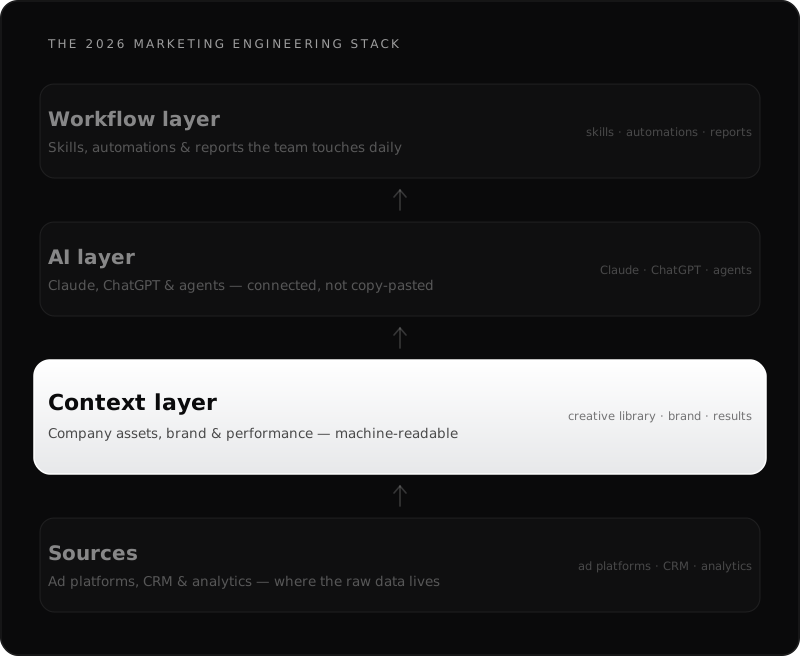
Sources
·Context layer
·AI layer
·Workflow layer
In creative-heavy teams, the context layer is the creative library itself: Uplifted's marketing MCP exposes every asset, tag, and result to the AI layer, and pre-built marketing skills give the workflow layer a running start.
The consolidation math behind this section: teams running five or fewer core tools generate 23% higher pipeline per headcount than teams managing 25+ (Forrester 2026 MOps Maturity), and true stack cost runs 2–3x visible license fees once integration and maintenance are counted (Flaiz, 2026) — which is why the engineer's first project is usually subtraction, not addition.
The engineer's first project is usually the context layer.
Start building it freeA realistic day in the role
Composites from published practitioner accounts look like this:
Review overnight automation logs, fix a failed workflow.
Improve a scoring or tagging model with last week's campaign data.
Scope an AI agent with the demand-gen team, then audit AI-crawler activity (GPTBot, ClaudeBot) and ship the technical fixes that affect how AI assistants present the brand.
Push an update to an internal dashboard.
Two things stand out
Half the job is maintenance of things that run without humans, and a growing slice is AI-search visibility — how the brand appears in ChatGPT, Claude, and Perplexity is becoming this role's territory, because it sits exactly at the technical-marketing seam.
How companies are hiring for it
Titles vary — marketing engineer, technical marketing engineer, digital marketing engineer, marketing automation engineer — but the postings share a spine: own the stack, automate the manual, make AI actually work with our data. It's appearing both as a dedicated hire at larger companies and as an evolution of the marketing-ops role at smaller ones.
- 01
Own the stack.
- 02
Automate the manual.
- 03
Make AI actually work with our data.
If you're the person on your team who already builds the spreadsheets everyone uses, you're closer to this role than the title suggests.
Frequently asked questions
Q. What is a marketing engineer?
A marketing engineer builds the systems marketing runs on — integrations between tools, automations for repetitive work, AI workflows connected to company data, and the tracking layer decisions depend on. Marketing ops runs the process; the marketing engineer builds the machinery.
Q. What's the difference between a marketing engineer and a marketing ops manager?
Ops owns the process — campaigns, calendars, governance. The engineer owns the machinery — the integrations, scripts, and AI connections underneath. In small teams it's one person wearing both; as stacks grow, the engineering half becomes its own job.
Q. Is marketing engineer a technical role?
Semi-technical and getting less so. Systems thinking matters more than syntax — AI coding tools now handle the scripting from plain-English specs, so the core skills are workflow design, data literacy, and precision.
Q. What is a technical marketing engineer?
Usually the same role with the technical half emphasized — closer to the data warehouse and the APIs, common in B2B and product-led companies. Digital marketing engineer and marketing automation engineer are sibling titles for the same spine of work.
Q. Do you need a degree or engineering background to become a marketing engineer?
No. Published practitioner paths run through growth marketing, marketing ops, and self-teaching far more often than computer-science degrees — the entry pattern is a marketer who started building automations and kept going. AI coding tools lowered the floor; systems thinking and marketing judgment are the actual prerequisites.
Q. What tools does a marketing engineer use?
The stack's four layers: source platforms (ads, CRM, analytics), a context layer where company assets and results live machine-readably, AI tools connected through MCP, and the workflow layer of skills and automations. The context layer is the differentiator — it's what makes every AI output specific instead of generic.
Build the context layer first.
Connect your creative, your brand, and your results in Uplifted — then plug your AI tools into it through one MCP.